
Atlassian Williams Racing Celebrates AI Innovation with New Livery and Tech Partnership

In a dramatic fusion of cutting-edge technology and elite motorsport, Atlassian Williams Racing is using its Formula 1 platform to showcase the power of AI-driven collaboration and workflow automation — emblazoned not just on its cars, but at the very heart of its operational transformation.
For the 2025 Formula One season, the iconic British team — reborn as Atlassian Williams Racing after a landmark title partnership — unveiled a striking special-edition livery at the Las Vegas Grand Prix that pays tribute to its title partner’s AI-powered capabilities. The all-black design, accented with rainbow highlights, was created to reflect both the bright lights of the Las Vegas Strip and the dynamic energy of Atlassian’s AI offerings.
But this livery is more than a visual flourish. It symbolizes a deeper transformation underway: the integration of AI-enhanced processes across one of the world’s most data-intensive and demanding sporting operations.
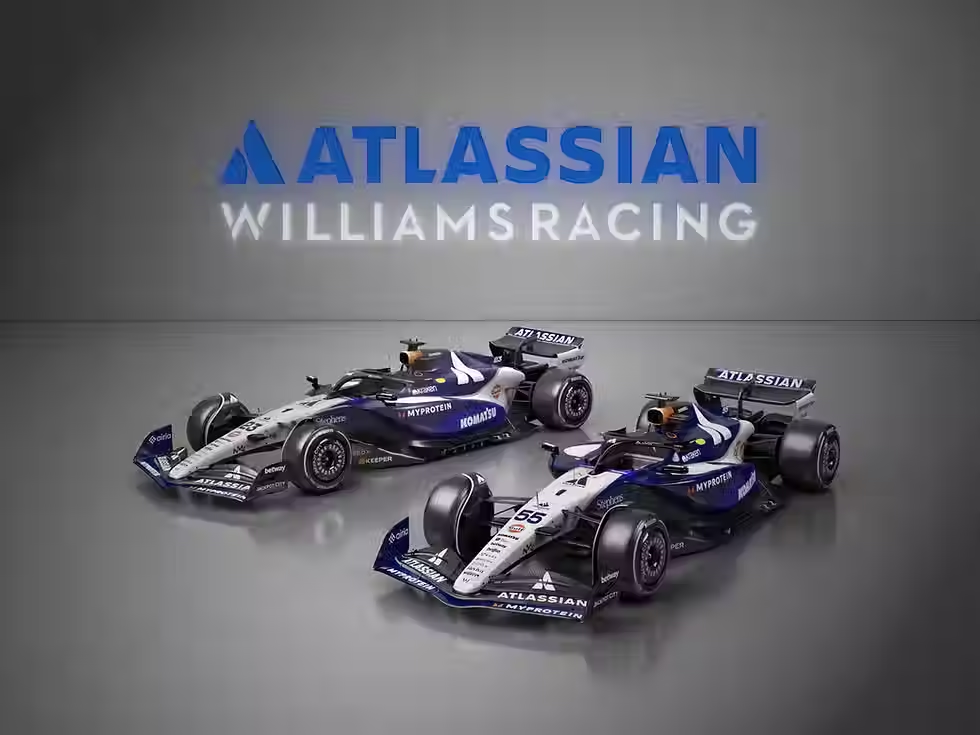
Speed, Precision and Atlassian AI-Powered Teamwork
To understand the significance of Atlassian’s involvement, it helps to look beyond paint schemes and sponsorship decals.
In February 2025, Williams Racing announced a long-term partnership with Atlassian — one described as the largest commercial deal in the team’s nearly half-century of competition. Under the agreement, Atlassian became both the Official Title Partner and Official Technology Partner, bringing its world-class collaboration software and generative AI capabilities to the forefront of the team’s operational processes.
Atlassian’s suite of products — including Jira, Confluence, Jira Service Management and the AI-powered layer known as Rovo — is now integrated deeply into the team’s workflow. Rather than relying on disconnected tools and spreadsheets, engineers and support staff can access real-time knowledge, align goals across departments, and streamline decision-making in an environment where milliseconds matter.
Rovo, in particular, acts as an AI teammate: surfacing expert insights, automating repetitive tasks, generating reports and helping teams move faster with less friction. For a Formula 1 team juggling thousands of data points — from car telemetry to logistics and personnel coordination — these capabilities are not just convenient; they are competitive.
From Silos to Seamless Workflow
James Vowles, Team Principal of Atlassian Williams Racing, has publicly emphasized the importance of cohesion in a high-pressure, high-complexity sport like Formula 1. The team’s revival strategy isn’t solely about engineering faster cars, but about building better workflows and reducing the cognitive load on its workforce of engineers, mechanics, strategists, and support staff.

Before the Atlassian partnership, many of these workflows were managed through isolated systems and manual processes. Today, those efforts are increasingly unified on a single platform where collaboration is not only visible but orchestrated.
One resulting benefit is evident during major race events like the Las Vegas Grand Prix, where every decision — from setup tweaks to race strategy — must be rapidly communicated and executed. The Atlassian System of Work helps eliminate the delays and misalignments that can cost valuable time, giving the team a sharper edge in the relentless pursuit of performance.
AI Everywhere: Beyond the Race Track
Atlassian’s influence extends beyond real-time race performance. The partnership also includes collaborations around digital transformation and AI orchestration with other tech innovators. For example, Williams Racing has brought on Airia as its Official AI Orchestration Partner, a platform designed to help organisations deploy and manage AI capabilities securely and at scale. This multiyear collaboration — showcased on the team’s cars at the Miami Grand Prix — underscores how AI orchestration is becoming as essential to elite motorsport as aerodynamics or tire strategy.
Meanwhile, technology consulting leader Brillio is involved as a Digital Transformation Partner, helping extend AI and data expertise across the team’s operations — both on and off the track.
This web of partnerships reflects a broader truth: Formula 1 is no longer just a test of engineering and driving skill. It is also a proving ground for advanced technologies that have relevance far beyond the racetrack.

AI as Motorsport’s Quiet Accelerator
Motorsport has long been a space where technology and precision intersect. But as teams like Atlassian Williams Racing embrace AI–powered tools, the sport is becoming a living case study in how collaboration platforms and machine intelligence can reshape performance at scale.
For fans, the spectacle on the track is thrilling. But behind the scenes, a quieter revolution is taking place — one where AI helps manage information flow, align global teams, and accelerate decision-making in an environment where every fraction of a second counts.
In this context, the AI-inspired livery at Las Vegas wasn’t just a marketing moment — it was a symbolic mark of an era where data and teamwork, powered by AI, are as essential to success as speed itself.
Why It Matters
For organizations outside of motorsport, the Atlassian Williams Racing story offers more than a feel-good headline. It’s a real-world example of how AI and collaboration technology can break down silos, amplify intelligence, and help teams perform under pressure — whether on the racetrack or in the marketplace.
In a world defined by velocity, precision and execution, AI isn’t just a tool. It’s a teammate — and none more vivid a demonstration of that reality exists today than Atlassian Williams Racing.


Comments